

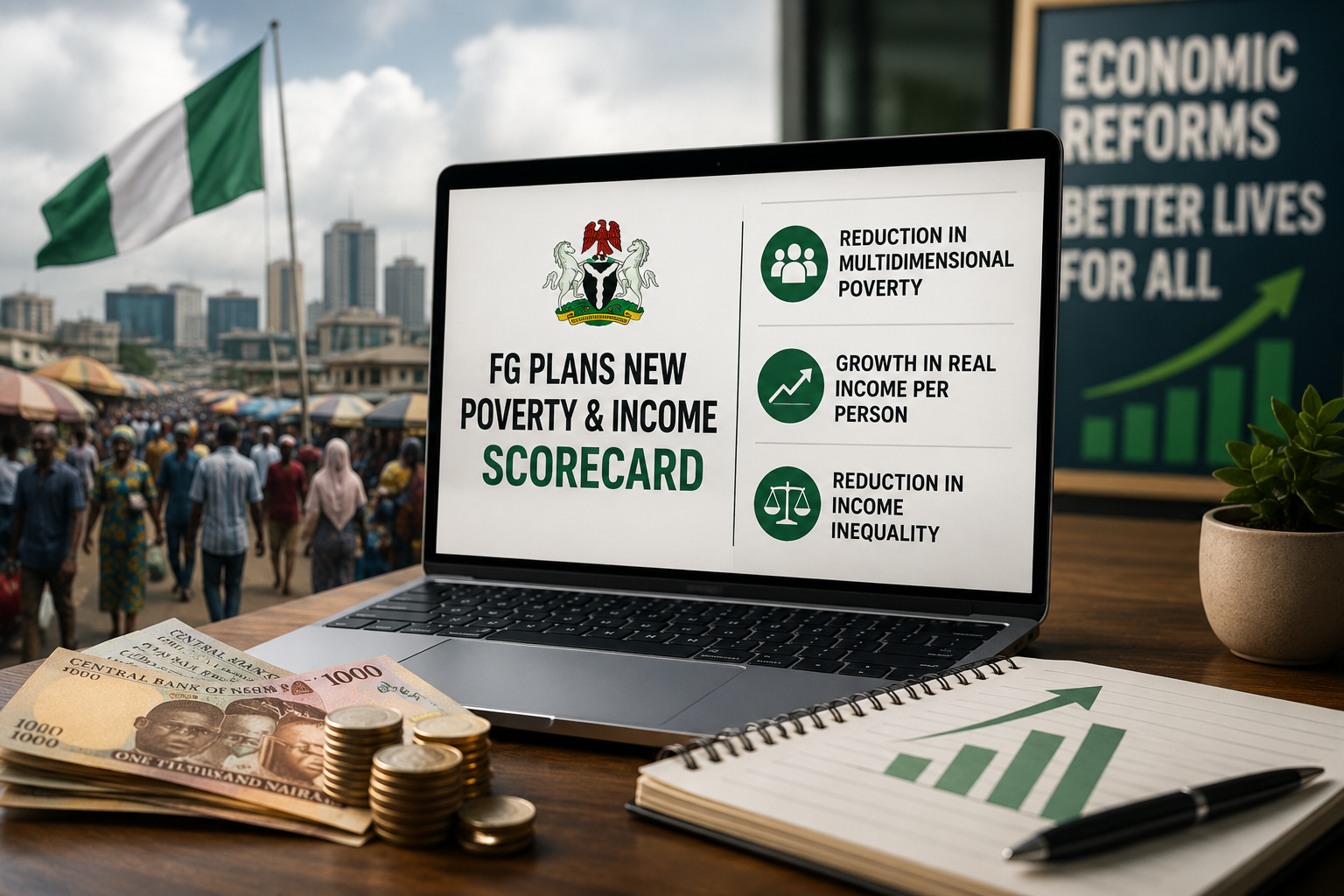
The Federal Government has announced plans to introduce a new “Shared Prosperity Scorecard” designed to measure whether Nigeria’s ongoing economic reforms are translating into real improvements in the lives of ordinary citizens.
The initiative, announced by the Chairman of the Presidential Committee on Fiscal Policy and Tax Reforms, Taiwo Oyedele, aims to track key indicators such as poverty levels, household incomes, and income inequality. According to the government, the scorecard will provide measurable evidence of whether recent economic reforms are improving living standards across the country.
Why Is the Government Introducing the Scorecard?
Since President Bola Ahmed Tinubu assumed office in 2023, the Federal Government has introduced several major economic reforms aimed at stabilizing Nigeria’s economy.
These reforms include:
- Removal of the petrol subsidy
- Liberalization of the foreign exchange market
- Ongoing tax reforms
- Measures to improve government revenue and attract investment
While these policies have been praised by international financial institutions and investors for strengthening macroeconomic stability, many Nigerians continue to struggle with high food prices, transportation costs, inflation, and the rising cost of living.
The proposed scorecard is intended to answer a key question many citizens have been asking:
Are these reforms actually improving people’s lives?
What Will the Scorecard Measure?
According to Oyedele, the government plans to focus on three main indicators:
1. Reduction in Multidimensional Poverty
Rather than looking only at income, multidimensional poverty considers factors such as access to education, healthcare, housing, sanitation, electricity, and other essential services.
A decline in multidimensional poverty would indicate that more Nigerians are experiencing better living conditions.
2. Growth in Real Income Per Person
The scorecard will monitor whether people’s incomes are increasing after accounting for inflation.
This is important because salary increases mean little if the cost of food, transport, rent, and other essentials rises even faster.
3. Reduction in Income Inequality
The government also wants to measure whether economic growth is being shared more evenly across society.
Lower inequality would suggest that the benefits of economic reforms are reaching a wider segment of the population rather than a small group.
These three indicators will form what the government describes as a “shared prosperity” measurement framework.
Why This Matters to Nigerians
For many households, the biggest concern is not whether economic indicators have improved but whether they can afford daily necessities.
In recent years, Nigerians have experienced:
- Rising food prices
- Higher transportation costs
- Increased electricity expenses
- More expensive healthcare
- Higher school fees
- Reduced purchasing power
Although government officials say inflation has started to ease and the foreign exchange market is becoming more stable, many families are still feeling financial pressure.
The proposed scorecard aims to determine whether improvements in the economy eventually translate into better living standards.
What Does the IMF Say?
The International Monetary Fund (IMF) has acknowledged that Nigeria’s economic reforms have improved investor confidence and strengthened macroeconomic stability.
However, the IMF has also noted that a large share of Nigerians continue to live in poverty and that food insecurity remains a serious challenge.
This highlights the difference between improvements in national economic indicators and the everyday experiences of citizens.
When Will the Scorecard Be Released?
At the time of the announcement, the Ministry of Finance had not provided a specific date for publishing the scorecard or explained how frequently it would be updated. The ministry is expected to oversee the development and publication of the indicators.
What Could This Mean for Ordinary Nigerians?
If implemented consistently, the scorecard could provide a clearer picture of whether government policies are improving people’s lives.
For citizens, it may offer:
- Greater transparency about the impact of economic reforms
- Better information for public debate
- A way to monitor government performance over time
- More focus on outcomes that directly affect households, such as income and poverty
However, experts say the value of the scorecard will ultimately depend on the quality of the data collected and whether the findings are published regularly and used to shape future policies.
Final Thoughts
Nigeria’s proposed Shared Prosperity Scorecard represents an effort to measure success beyond traditional economic statistics. Instead of focusing only on GDP growth or government revenue, the initiative seeks to answer a more practical question: Are Nigerians actually better off?
As the country continues its economic reform journey, many citizens will be watching closely to see whether improvements in economic performance are reflected in lower poverty, higher real incomes, and a better quality of life.
The effectiveness of the scorecard will likely depend on transparent reporting, reliable data, and the government’s willingness to use the findings to guide future policy decisions.
0 Comments